This guide is continuously maintained and verified by our resident Andean mountain leaders, ensuring accurate permit guidance, altitude protocols, and route recommendations for travelers in Peru.
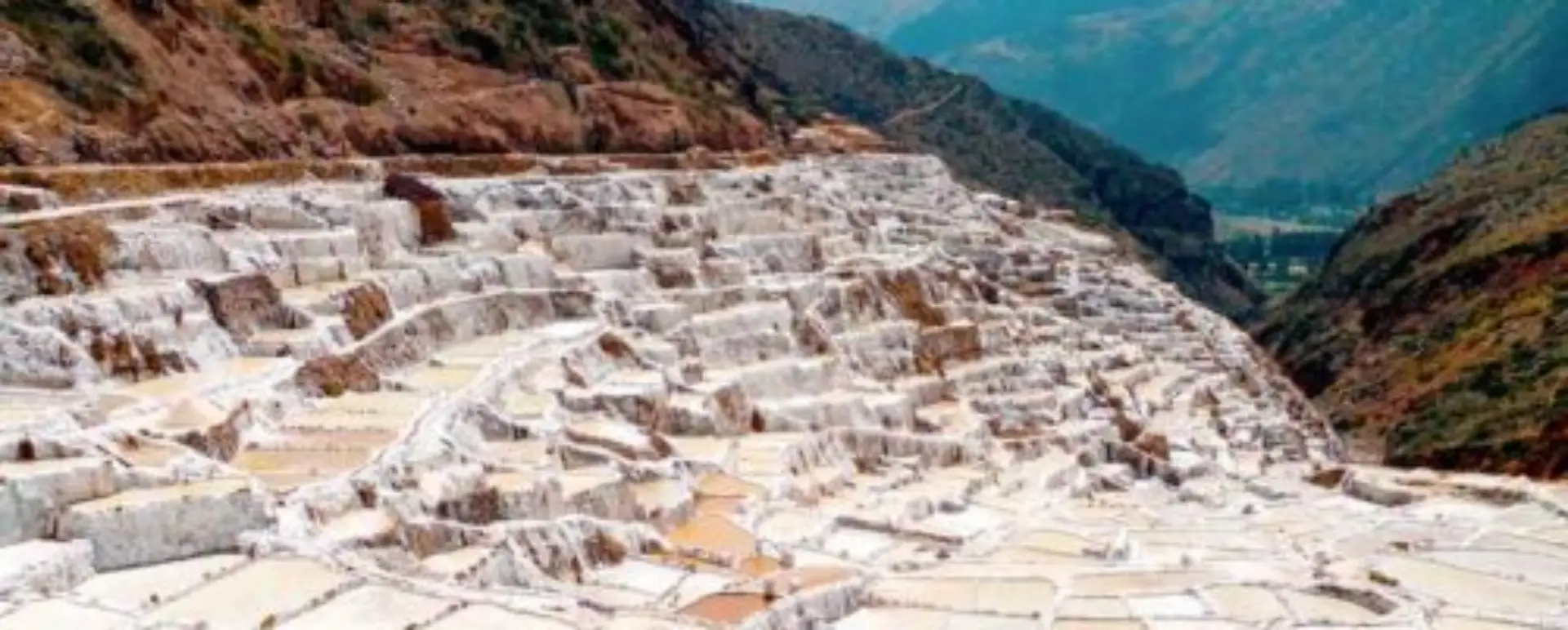
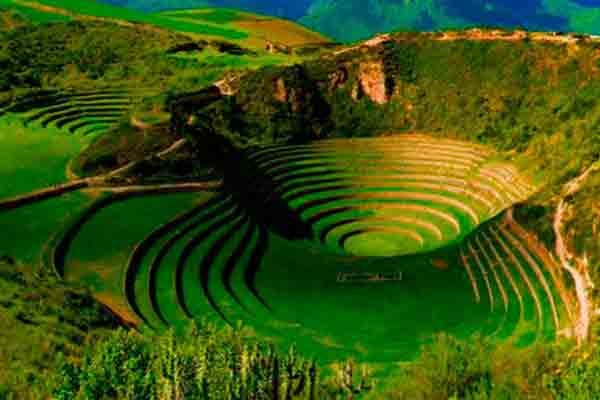
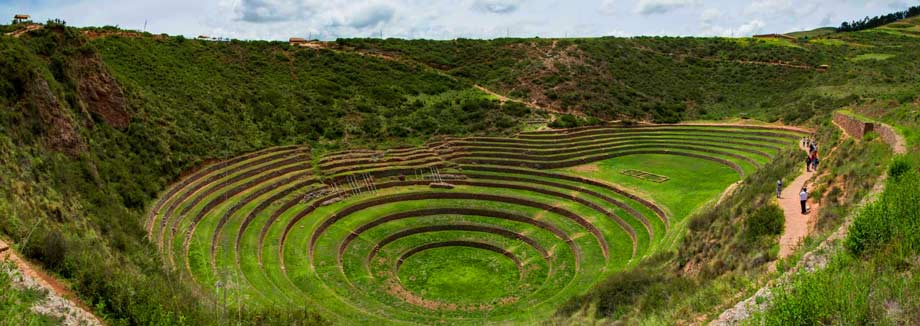
Maras and Moray are two sites on the high plain above the Sacred Valley, about 1 hour to 1 hour 30 minutes from Cusco and usually visited together. Moray is a group of circular Inca terraces in natural hollows, at about 3,480 m; the salt pans of Maras are some 4,500 small salt pools on a hillside, worked by local families since before the Incas. Moray is on the Boleto Turístico; the salt pans have their own entrance fee.
Maras and Moray at a glance#
| Moray | Maras salt pans | |
|---|---|---|
| What it is | Circular Inca terraces in three natural hollows | About 4,500 salt pools fed by a salt-water spring |
| Altitude | About 3,480 m | About 3,200 m |
| Ticket | Boleto Turístico, Circuit III (S/ 70, 2 days) or integral | S/ 20 foreigners, S/ 15 Peruvians, paid in cash |
| Hours | 7:00 a.m. to 5:00 p.m. | About 9:00 a.m. to 5:00 p.m. |
| Time needed | About 1 hour | About 1 hour |
The town of Maras, at about 3,300 m, lies between the two: Moray is about 7 km from the town, and the salt pans about 6.6 km by road (or about 3.7 km on foot, downhill).
Moray: the circular terraces#
Moray has three large hollows, and the Incas lined them with rings of terraces; the main one has twelve levels and is about 30 m deep. Each level gets a different amount of sun and wind, so the temperature changes from the rim to the bottom, which is warmer; a difference of up to 15 °C is often quoted. Because of this, most researchers think Moray was used to grow crops in different conditions, as a kind of agricultural test site, but there are no written records of its purpose.
The salt pans of Maras#
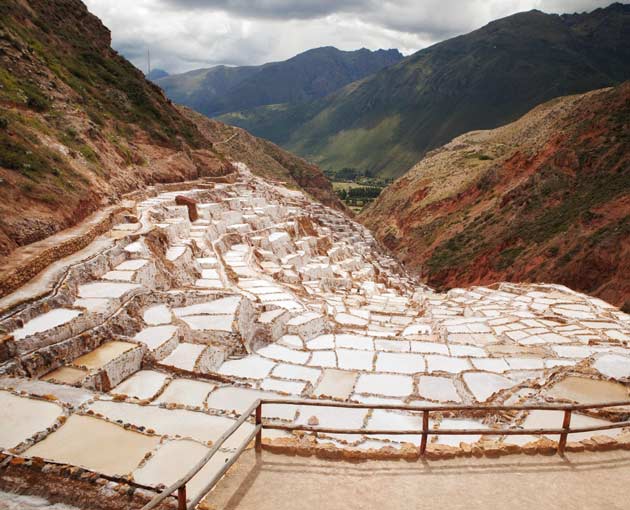
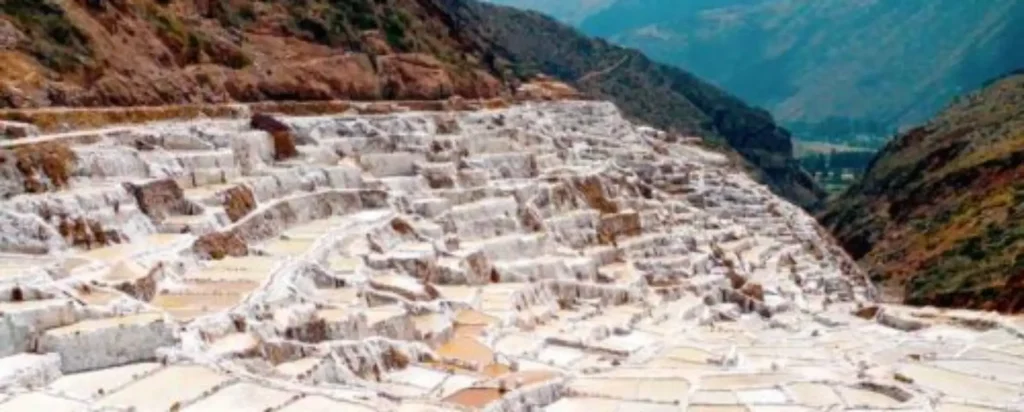
A spring of very salty water comes out of the mountain above the salt pans, and narrow channels carry it to thousands of shallow pools built on terraces. Families close a pool, let the water evaporate in the sun and scrape off the salt, as people here did before the Incas: archaeologists date the first salt production to the Early Horizon, long before the Inca period. The salt pans are run by Marasal, a company owned by the communities of Maras and Pichingoto, whose 633 families work the pools.
- Entrance: S/ 20 for foreigners and S/ 15 for Peruvians since January 2024 (it was S/ 10 for everyone before), paid in cash at the entrance. It is not on the Boleto Turístico.
- Visiting: since June 2019 visitors cannot walk between the pools; you see them from the path and viewpoints along the edge.
- Buying salt: stalls at the entrance sell salt from the pools.
The town of Maras#
Maras is a small farming town of adobe houses and a colonial church, on the plain between Moray and the salt pans. Most visitors only drive through it, but it is a good place to start the walk down to the salt pans.
How to visit Maras and Moray#
- On a tour: half-day tours from Cusco visit both, and many Sacred Valley tours add them to Ollantaytambo or Chinchero.
- By taxi: from Cusco, or from Urubamba in the valley, with the driver waiting at each site.
- On foot or by bike: walk from Maras to the salt pans and on down to the village of Pichingoto in the valley, or join a bike tour.
- By ATV or on horseback: see our guide to adventure tours in the Sacred Valley.
Peru’s tourism board has an official video of Maras and Moray.
Tips#
- Bring your Boleto Turístico for Moray and cash in soles for the salt pans.
- Both sites are exposed: bring a hat, sunscreen and a jacket for the wind.
- From May to September the paths are dry; in the rainy season the path down to the salt pans can be muddy.
Maras and Moray on our tours#
Our Cusco Family Holiday: 8 Days visits Pisac, Moray, Maras and Ollantaytambo on its Sacred Valley day. For the rest of the valley, see our Sacred Valley guide.

Written by Joel Cárdenas Gonzales
Founder & CEOFounder and CEO of Southern Peru Explorers since 2009. Born in Cusco and trained as an official tour guide at Instituto Khipu. About the author