Table of Contents (13 Sections)
- 1 Where is Manu National Park?
- 2 How big is Manu, and is it a UNESCO site?
- 3 What are the Cultural Zone and the Reserved Zone?
- 4 How do you get to Manu from Cusco?
- 5 How many days do you need for Manu?
- 6 What wildlife can you see in Manu?
- 7 When is the best time to visit Manu?
- 8 Do I need vaccines for Manu?
- 9 Can I visit Manu without a tour?
- 10 What are the lodges like? Is there electricity and internet?
- 11 Is Manu suitable for children and older travelers?
- 12 What should I pack for Manu?
- 13 Manu or Tambopata?
Manu National Park, in the Cusco and Madre de Dios regions of south-eastern Peru, is one of the largest protected areas in the country and one of the richest in species. These are the questions travelers ask us most often before booking a Manu tour, answered with figures from SERNANP, the Peruvian national parks service, and from UNESCO.
Where is Manu National Park?#
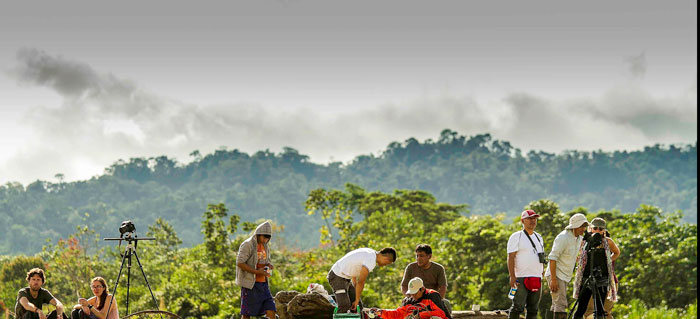
It lies on the eastern slopes of the Andes, in the provinces of Paucartambo (Cusco) and Manu (Madre de Dios). The park runs from the puna, above 4,000 m, down to the lowland rainforest at about 300 m, where the Manu River meets the Alto Madre de Dios. Visitors reach it overland from Cusco, the nearest city.
How big is Manu, and is it a UNESCO site?#
The park was created on 29 May 1973 and, after it was enlarged in 2002, covers 1,716,295 ha. UNESCO declared the Manu Biosphere Reserve in 1977, with the park as its core, and inscribed the park on the World Heritage List in 1987 for its ecosystems and its biodiversity.
What are the Cultural Zone and the Reserved Zone?#
Tour operators use these two names, but they are not the official zones of the park:
- Cultural Zone: the buffer zone of the park, in the Kosñipata and Alto Madre de Dios valleys, with the towns of Pilcopata and Atalaya, most of the lodges, the cloud-forest birdwatching and lakes such as Machuwasi. Our 4- and 5-day tours take place here.
- Reserved Zone: the lower Manu River, declared a reserved zone in 1980 and part of the national park since 2002. It is now the park’s tourism and recreation zone, with the oxbow lakes Cocha Salvador and Cocha Otorongo, and it can only be visited in guided groups registered with the park. Our 7-day expedition goes there.
- The rest of the park: most of its area is strictly protected and closed to tourism.
How do you get to Manu from Cusco?#
By road. The route passes Paucartambo, about 110 km from Cusco, crosses the eastern range of the Andes at up to 3,800 m near the park’s Acjanaco control post, and descends through the cloud forest to Pilcopata, about 7 hours from Cusco with stops. A road continues to Atalaya, a river port on the Alto Madre de Dios, where the boats start. Going on to Boca Manu and the Manu River takes most of another day by boat.
How many days do you need for Manu?#
At least 4, because the drive from Cusco takes most of the first and the last day. In 4 or 5 days you see the cloud forest and the lowlands of the Cultural Zone; to reach Cocha Salvador and Cocha Otorongo on the Manu River you need about 7 days.
| Tour | Days | Where you go | Price per person |
|---|---|---|---|
| Manu National Park Tour 4 Days | 4 days / 3 nights | Cloud forest, Pilcopata, Atalaya, Machuwasi | USD 450 |
| Manu National Park Tour 5 Days | 5 days / 4 nights | Cloud forest, a river safari, hot springs, Machuwasi lake | USD 600 (minimum 2) |
| Manu Expedition 7 Days | 7 days / 6 nights | Boca Manu, the Blanquillo clay lick, Cocha Otorongo, Cocha Salvador | USD 1,450 (minimum 2) |
What wildlife can you see in Manu?#
SERNANP counts more than 1,000 bird species in the park, some 4,385 plant species and more than 1,300 butterflies; UNESCO lists 13 species of primates and 8 of wild cats. Mammal counts vary by source, from about 160 to more than 200 species. What you see depends on the part of the park you visit:
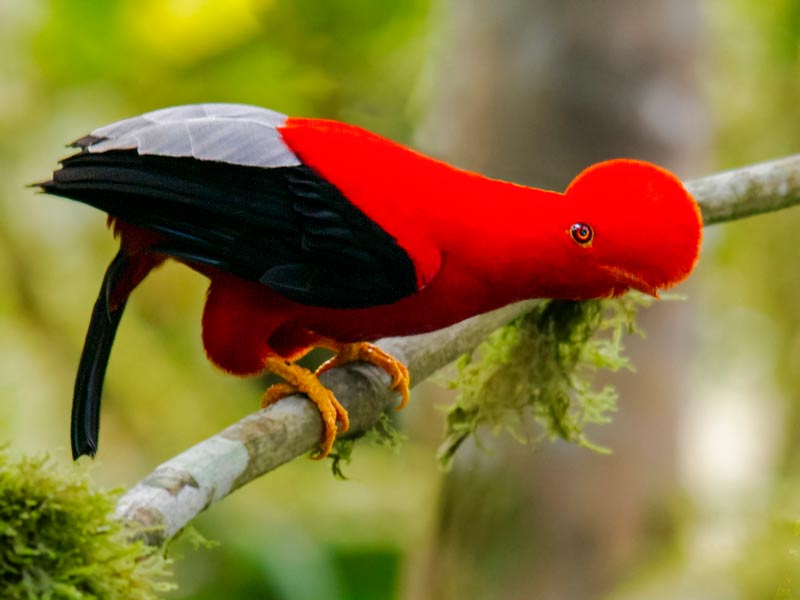
- Cloud forest: the Andean cock-of-the-rock, Peru’s national bird, which gathers at display sites called leks, as well as trogons and tanagers; the spectacled bear lives here but is rarely seen.
- Rivers and lakes: giant river otters (in 2022 the park counted 57 in 9 family groups), caimans, capybaras, turtles, herons and king vultures.
- Lowland forest: several kinds of monkeys, peccaries, tapirs at clay licks, macaws and parrots. Jaguars live in Manu, but sightings are rare.
No sighting can be guaranteed: animals are wild and the forest is dense. Binoculars make a big difference, especially for birds and monkeys high in the trees. For the lowlands near Puerto Maldonado, see our guide to Tambopata National Reserve animals.
When is the best time to visit Manu?#
You can visit all year. SERNANP gives May to September as the dry season, and May to October generally has less rain, lower rivers and easier travel. From November to April it rains more often and the rivers rise, but the forest is at its greenest. Rain varies a lot inside the park, from about 1,500 mm a year in the high south to more than 8,000 mm in the north-west.
From June to August, cold fronts from the south called friaje reach the lowlands of Madre de Dios 6 to 10 times a year, according to SENAMHI, and for a few days night temperatures can drop to about 11 °C. Pack a warm layer at any time of year, also for the road over the Andes.
Do I need vaccines for Manu?#
- Yellow fever: the vaccine is not required to enter Peru, but the US CDC recommends it for travelers aged 9 months or older going below 2,300 m in the Cusco region and Madre de Dios, which includes the Manu lowlands. Peru’s health ministry also recommends it for these jungle areas. It protects you from 10 days after the shot.
- Malaria: the CDC lists a risk in all areas below 2,500 m east of the Andes, so ask your doctor about prevention. In practice cases are few here: to August 2026 the health ministry recorded 3 in Madre de Dios and 1 in Cusco, against 15,951 in all of Peru, almost all in Loreto.
- Bites: use a repellent with DEET and wear long sleeves and long trousers at dawn and dusk.
Can I visit Manu without a tour?#
The Manu River sector, with Cocha Salvador and Cocha Otorongo, cannot be visited independently: the park rules require a guided group registered in advance. The buffer zone around Pilcopata and Atalaya is outside the park, but its lodges, boats and guides are booked through operators. The park entrance fees are included in our tours.
What are the lodges like? Is there electricity and internet?#
Lodges in Manu are simple: rooms with beds and mosquito nets, and meals prepared on site. Electricity often comes from a generator and works only a few hours a day, and beyond Pilcopata there is little or no phone signal or internet. Bring a power bank, a headlamp and spare camera batteries.
Is Manu suitable for children and older travelers?#
Yes, if they are in normal health. The walks are slow and guided and most of the travel is by vehicle and boat. The long drives from Cusco, the heat, the humidity and the insects are what make it tiring, so the 4-day tour is the gentlest option. Tell us the ages of the travelers when you book.
What should I pack for Manu?#
- Your original passport, which is checked on the way
- Light, quick-dry long-sleeved shirts and long trousers, in light colors
- A rain jacket or poncho, and a fleece for the road over the Andes
- Walking boots or trail shoes, and sandals for the lodge
- Insect repellent, sunscreen, a hat and sunglasses
- A headlamp, binoculars and a dry bag for your phone and camera
- Cash in small notes in soles: there are no ATMs after Pilcopata
Manu or Tambopata?#
Tambopata is quicker: a 45-minute flight from Cusco to Puerto Maldonado and a lodge near Lake Sandoval, in 3 or 4 days. Manu takes longer, because you travel overland, but you see the whole descent from the Andes through the cloud forest to the lowlands. Compare them on our Peru Amazon tours page, or contact us and tell us how many days you have.

Written by Joel Cárdenas Gonzales
Founder & CEOFounder and CEO of Southern Peru Explorers since 2009. Born in Cusco and trained as an official tour guide at Instituto Khipu. About the author