


This is one of Peru’s most fascinating destinations, a place where ancient civilizations, vast desert landscapes, and archaeological mysteries come together. Located on Peru’s southern coast, approximately 450 kilometers (280 miles) southeast of Lima, the region is best known around the world for the Nazca Lines, enormous geoglyphs etched into the desert more than a thousand years ago.
But this destination is much more than its famous lines. The area preserves evidence of ancient cultures, remarkable archaeological sites, impressive aqueducts, and a landscape shaped by one of the driest environments on Earth. For travelers interested in history, archaeology, and unexplained ancient mysteries, it offers an unforgettable experience.
The Nazca Lines: Peru’s Most Famous Geoglyphs
The Nazca Lines are undoubtedly the main attraction in the region. Scattered across the desert between Nazca and Palpa, these enormous designs depict animals, plants, geometric shapes, and mysterious figures that can be fully appreciated from above.
Among the best-known figures are the Hummingbird, Condor, Monkey, Spider, Dog, and Astronaut. Some designs extend for hundreds of meters, making their enormous scale difficult to appreciate from ground level.
The geoglyphs were created by removing the darker surface stones of the desert to reveal the lighter-colored ground beneath. Thanks to the extremely dry and stable climate of the region, many of these designs have survived for centuries.
The exact purpose of these ancient geoglyphs continues to be debated by researchers. They are generally associated with the religious and ceremonial practices of ancient societies, although their precise meaning remains one of the great archaeological questions of Peru.
In 1994, the Nazca Lines and Geoglyphs were inscribed on the UNESCO World Heritage List, recognizing their outstanding cultural and archaeological importance.
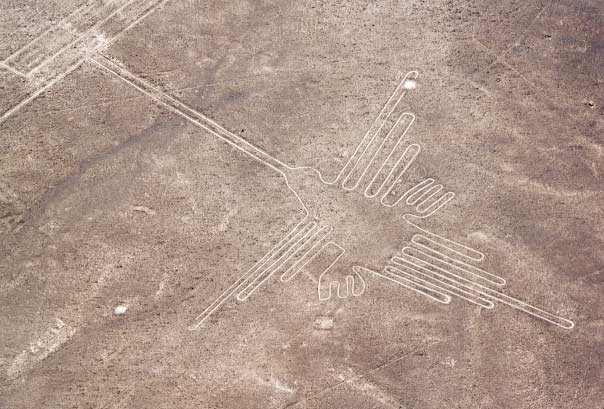
A Bird’s-Eye View of the Nazca Lines
One of the most popular ways to experience the geoglyphs is by taking a scenic flight over the Nazca Lines.
From the air, travelers can see the enormous figures spread across the desert and better understand their scale and design. The flight typically provides views of several of the most famous geoglyphs while offering a completely different perspective of the surrounding desert.
For many visitors, seeing the figures from above is the highlight of their trip to this desert destination. The contrast between the immense desert and the precisely drawn shapes creates a remarkable aerial experience.
The Ancient Nazca Civilization
The region takes its name from the Nazca civilization, an ancient culture that developed along Peru’s southern coast approximately between 100 BC and AD 800.
These people were highly skilled in agriculture, pottery, textiles, and ceremonial architecture. Despite living in one of the driest regions of Peru, they developed sophisticated methods for managing water and cultivating crops.
Their artistic traditions are particularly impressive. Nazca pottery is famous for its vivid colors and representations of animals, plants, people, and supernatural beings.
The archaeological remains left by this civilization provide valuable insights into the beliefs, technology, and daily life of one of ancient Peru’s most fascinating cultures.
Cantalloc Aqueducts: Engineering in the Desert
One of the region’s most impressive archaeological attractions is the Cantalloc Aqueducts, an ancient water-management system located near the city.
In an environment where rainfall is extremely limited, access to water was essential for survival. The ancient inhabitants developed underground and open-air channels that allowed them to collect and transport groundwater toward agricultural areas.
Some of these aqueducts remain visible today, including spiral-shaped entrances that descend into the ground. These structures demonstrate the remarkable understanding that ancient communities had of their environment and water resources.
Visiting Cantalloc provides a different perspective on this ancient civilization. Instead of focusing only on the region’s mysteries, it reveals the practical knowledge and engineering skills that allowed ancient societies to thrive in the desert.
Chauchilla Cemetery: A Journey into Ancient Nazca
Another fascinating archaeological site is the Chauchilla Cemetery, located approximately 30 kilometers from the city.
The cemetery contains ancient tombs associated with the Nazca culture and later populations. Some of the archaeological remains provide evidence of traditional funerary practices, including the use of textiles, ceramics, and other objects placed with the deceased.
The arid desert climate helped preserve many archaeological materials for centuries, making Chauchilla an important site for understanding ancient burial traditions.
Walking through the cemetery also highlights the extraordinary environmental conditions of the southern Peruvian desert, where the lack of rainfall has contributed to the preservation of archaeological remains.
The Desert Landscapes of Nazca
Nazca is surrounded by an impressive desert landscape characterized by enormous open spaces, rocky hills, sand-covered valleys, and an almost endless horizon.
The stark scenery provides a powerful contrast to the green valleys found in other parts of Peru. Here, the desert dominates the landscape, while small agricultural areas appear wherever ancient and modern irrigation systems provide access to water.
For photographers and adventure travelers, the region offers exceptional opportunities to capture the dramatic relationship between the desert environment and the archaeological remains of ancient civilizations.
Palpa and the Ancient Geoglyphs
North of Nazca lies Palpa, another area known for its impressive ancient geoglyphs.
Although the Nazca Lines receive most of the international attention, the Palpa region contains numerous figures and geometric designs associated with earlier cultures. Some of these geoglyphs are located on hillsides and can be viewed from the surrounding landscape.
Exploring Palpa allows travelers to discover another chapter in the history of Peru’s southern desert and understand that the tradition of creating enormous geoglyphs was not limited to the Nazca civilization alone.
The Mysterious Astronaut and Other Famous Figures
Among the most intriguing Nazca geoglyphs is the figure commonly known as the Astronaut or Man of the Mountain.
The enormous human-like figure is carved into the side of a desert slope and has become one of the most recognizable images associated with the Nazca Lines. Its unusual appearance has inspired countless theories and interpretations over the years.
However, many of the more sensational explanations surrounding the Nazca Lines are not supported by archaeological evidence. The geoglyphs are best understood within the cultural and religious context of the ancient societies that created them.
This combination of archaeological knowledge and unanswered questions is precisely what makes Nazca so captivating.
When to Visit Nazca
Thanks to its extremely dry desert climate, Nazca can be visited throughout the year. Rainfall is very limited, and sunny conditions are common.
If you plan to take a flight over the Nazca Lines, it is important to consider that flights depend on weather and operational conditions. Morning flights are often popular because visibility can be favorable, although conditions can vary from day to day.
Travelers should also be prepared for the desert climate, bringing sun protection, comfortable clothing, water, and appropriate footwear.
Discover Nazca with Southern Peru Explorers
Nazca is a destination where ancient mysteries, archaeological discoveries, and dramatic desert landscapes come together. From the unforgettable Nazca Lines and the engineering of the Cantalloc Aqueducts to the ancient tombs of Chauchilla and the geoglyphs of Palpa, the region offers much more than a single attraction.
For travelers exploring southern Peru, Nazca provides an opportunity to step into a landscape shaped by ancient civilizations and discover some of the most extraordinary archaeological remains in the country.