


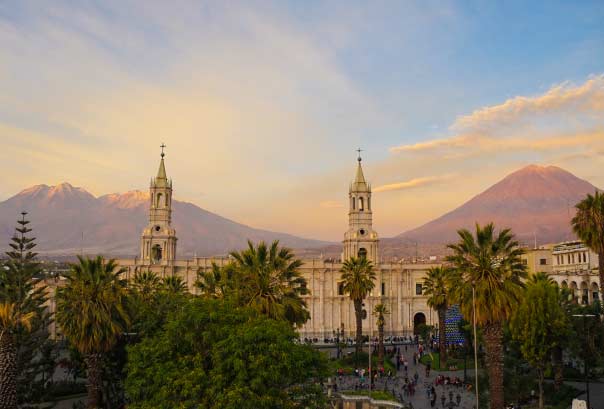
Arequipa is, quite rightly, one of the most singular cities in Peru. Built almost entirely from sillar, a whitish volcanic stone that gives the city its distinctive color, this southern Peruvian city combines colonial architecture, an imposing volcanic setting, and a character all its own that sets it apart from the rest of the country. It’s not for nothing that it’s known as the “White City.”
A city carved from volcanic stone
Sillar, quarried from sites near the Chachani volcano, is the material that visually defines Arequipa. Churches, mansions, cloisters, and even the streets of the historic center are built from this pale stone, which also lends itself perfectly to fine carving and elaborate architectural detail. The result is a luminous historic center, declared a UNESCO World Heritage Site, where the Andean sunlight brings out every façade.
Arequipa’s Plaza de Armas, framed by stone-arched portals and presided over by its imposing Cathedral, is considered one of the most beautiful in Peru. A few blocks away stands the Church of the Compañía de Jesús, famous for its mestizo Baroque façade carved with local flora and fauna motifs a perfect example of how Andean artisans wove their own worldview into Spanish colonial art.

The Santa Catalina Monastery: a city within the city
If there’s one place that sums up the spirit of Arequipa, it’s the Santa Catalina Monastery. Founded in the 16th century, this religious complex covers nearly 20,000 square meters and functions as a true citadel within the city, with its own streets, plazas, cloisters, and houses painted in deep indigo, ochre, and red tones. For centuries it was closed off from the outside world, home to cloistered nuns, and today it’s one of the most photographed sites in Peru for the sheer power of its colors and architecture.
Surrounded by volcanoes
Unlike other historic cities in the country, Arequipa stands out for its geographical setting: it’s flanked by three volcanoes El Misti, Chachani, and Pichu Pichu which dominate the horizon from almost anywhere in the city. El Misti, with its nearly perfectly symmetrical silhouette, is Arequipa’s most recognizable symbol and a popular challenge for trekkers and mountaineers in the region.
This volcanic setting doesn’t just shape the landscape it has also shaped the city’s geological and architectural history, being the very source of the sillar stone Arequipa was built from.
The Colca Canyon, right at the city’s doorstep
A few hours from the city lies the Colca Canyon, one of the deepest canyons in the world, with sections dropping more than 3,000 meters. Beyond its striking scenery, the canyon is known as home to the Andean condor, the largest flying bird on the continent, which can be seen soaring over the canyon, especially in the early morning hours, from the Cruz del Cóndor viewpoint.
The valley also preserves towns with pre-Hispanic agricultural terraces still in use today, along with communities that keep alive textile traditions and festivals unique to the Colca region.

Flavors of southern Peru
Arequipan cuisine is among the most celebrated in the country. Dishes like rocoto relleno (stuffed spicy pepper), chupe de camarones (shrimp chowder), ocopa arequipeña, and adobo traditionally served on Sunday mornings reflect a cuisine bursting with flavor, with a character all its own within Peru’s already renowned culinary landscape. Arequipa’s traditional “picanterías,” many with more than a century of history, remain the best places to try these dishes in their most authentic form.
Discover it with us
Sillar architecture, colonial history, volcanoes, deep canyons, and a cuisine with its own strong identity make Arequipa a destination that surprises those expecting “more of the same” in southern Peru. At our agency, we design tours led by local guides to explore both the historic center and the volcanic landscape surrounding the city, including excursions to the Colca Canyon for those looking to go beyond the city limits.